November 2020
A newsletter brought to you by Animal Care Services on behalf of Dr. Helen M. Burt, Associate Vice-President Research & Innovation to faculty, staff, students, and community members in the UBC Animal Care & Use Program.
In this issue:
- CCAC: Harry C. Rowsell Award | Annual Report 2019-2020
- UBC Veterinarians
- ACC: Online Ethics Training Certificates | Review Dates and Deadlines | Technicians’ Meeting
- ACUP Procurement: Workday updates
- Mosaic Enhancement Project
- Post Approval Monitoring
- ACS Training: Resumption of in-person training courses | Workday and financial process updates
- ACUP Facilities Updates: ACS Workday and financial process updates | ACS holiday blackout period
- ACUP SharePoint
CCAC Update
2021 Harry C. Rowsell Award for Outstanding Service
The Canadian Council on Animal Care (CCAC) is pleased to announce that the call for nominations for the Harry C. Rowsell Award for Outstanding Service to the CCAC is now open!
This award recognizes individuals who have made exceptional contributions to the CCAC, and who uphold the highest standards in the ethical care and use of animals in Canadian science through dedication, competence, performance, service, and/or ingenuity. This award is open to anyone working in the field of animal care and use, including, but not limited to, animal welfare experts, animal laboratory technicians, teachers, researchers, veterinarians, and animal care committee members.
Please visit the CCAC website for the nomination requirements and selection criteria.
CCAC Annual Report 2019-2020 Is Now Available
The Canadian Council on Animal Care (CCAC) is pleased to announce the publication of the CCAC Annual Report 2019-2020, “Ensuring the Welfare of Animals in Science.” Discover the latest developments and accomplishments related to the CCAC's strategic plan and objectives, as well as future activities. The report names a number of contributors from UBC, including Mr. Michael Brunt, Dr. Helen M. Burt, Dr. Agnes Lacombe, Dr. Joanna Makowska, Dr. Alexandra Protopopova, Dr. Dan W. Rurak, Dr. Cathy Schuppli, Dr. Daniel Weary, and Dr. Ian D. Welch.
UBC Veterinarians
Our clinical veterinarians can assist you with animal care protocol development and pre-review, model development, and animal welfare.
For more information, please visit our SharePoint site or contact our team:
| Veterinarian | Phone | Portfolio | |
|---|---|---|---|
| Dr. Ian Welch, Director, Veterinary Services & Research Support & University Veterinarian | 604-827-3469 | ian.welch@ubc.ca | FINDER |
| Dr. Shelly McErlane, Senior Clinical Veterinarian and Head of Training | 604-827-3701 | shelly.mcerlane@ubc.ca | CDM, BRC, ICORD, JBRC, UBCO |
| Dr. Po-Yan Cheng, Clinical Veterinarian | 604-827-0964 | po-yan.cheng@ubc.ca | Biological Sciences, HLI, MBF, MOF |
| Dr. Brittany Imlach, Clinical Veterinarian | 604-822-6696 | brittany.imlach@ubc.ca | CCM |
| Dr. Laura Mowbray, Clinical Veterinarian | 604-827-3899 | laura.mowbray@ubc.ca | CCM, UBC Dairy Education and Research Centre, UBC Farm |
| Dr. Cathy Schuppli, Clinical Veterinarian | 604-827-3848 | cathy.schuppli@ubc.ca | CDM, ARU/PDC |
| Dr. Davis Wood, Clinical Veterinarian | 604-822-6257 | davis.wood@ubc.ca | BCCRC, BCCHR, Beaty Biodiversity Museum, CMMT, Forestry, InSEAs |
| Evenings and weekends | 604-822-9000 | - | - |
Animal Care Committee (ACC)
CCAC Online Ethics Training Certificates
The CCAC online ethics training certificate number is now system-generated. Along with the older certificate numbers that you are already familiar with, here is an example of the new format:
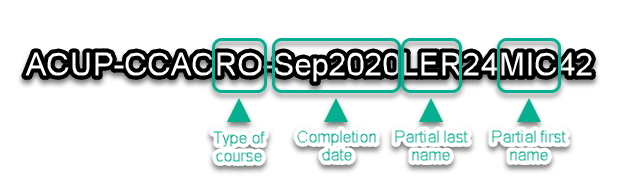
CCAC online ethics certificate naming convention
| Code | Details |
| RO | Rodent course |
| Sep2020 | Course completion date |
| LER MIC | Portion of student's last and first name |
The course abbreviations have not changed. They remain:
| Code | Type of course |
| RO | Rodent (as shown in the example above) |
| FA | Farm |
| FI | Fish |
| BI | Bird |
| OT | Other |
ACC Review Dates and Deadlines
When submitting items to the ACC for review (new protocols, responses to queries, amendments, renewals), please ensure you check our website for submission deadlines and review dates on our Submission Deadlines page.
Review timelines vary depending on when an item is submitted for review in the deadline cycle. While the ACC does its best to accommodate items which come in urgently off-cycle, ACC reviewers are on a volunteer basis, and it is not always possible to accommodate urgent requests for off-cycle submissions. Given this, we encourage researchers to pay close attention to expiry notices and ensure their protocols are renewed on time.
ACC Technicians’ Meeting
While it may look different this time around (no food, more videos!), the ACC is looking to plan our Technicians’ Meeting for January or February 2021. If you have suggestions for topics you would like covered, or if you have something you would like to present yourself, please reach out to Suzanne at suzanne.richardson@ubc.ca.
ACUP Procurement
Phased Resumption of Research Activities
In response to COVID-19, the following services are limited to exempted research users:
- Animal transfers between facilities
- Transportation of animals
- Ordering of any new animals
For more information, please visit the Office of the Vice-President Research + Innovation.
AVP orders are placed twice a week. Please submit any order requests by Monday/Wednesday 11 a.m. to ensure they are included in that day's order. Any urgently required pharmaceuticals/supplies continue to be ordered ASAP.
ACUP Procurement Workday Updates
Effective November 1, 2020, all orders will be charged via Workday and require pre-approval authorization. The PI and their authorized account users as communicated via an Internal Sales Delivery form to UBC ACS Finance are able to request orders. Orders will not be processed without complete Worktag information. For more information, please see ACS Workday and financial process updates.
Ordering Animals and AVP Supplies in Mosaic
All animal and supply ordering requests are available through Mosaic. As an alternative to submitting order forms to anca.orders@ubc.ca, order requests through Mosaic will allow for faster and more transparent processing.
See here for a 2-minute video tutorial: How-to Animal Ordering with Mosaic.
Associated Veterinary Purchasing (AVP) Catalog
The AVP catalog is uploaded into Mosaic so researchers can request any products available via AVP directly through Mosaic.
As reference, researchers can also view the AVP catalog by visiting avpbc.com before submitting order requests to Animal Care Services. Please use the following credentials to view the AVP catalog:
- Customer Number: 228628
- Username: ACS Users
- Password: 228628
AVP is a veterinarian-owned buying group and distributor of pharmaceuticals. AVP sells only to licensed veterinarian healthcare professionals of British Columbia. Researchers are encouraged to login to the AVP catalog to view pricing and product availability only. Orders for AVP products must still be placed to the UBC ACUP Procurement team.
Deliveries
As a courtesy, if you are aware of any construction activities at or around your facility that may impact deliveries, please contact anca.orders@ubc.ca with details so we can ensure animals are delivered in a timely manner.
Contact
For any questions or concerns regarding animal orders, transfers, procedures, and technical work, please contact Janice Kang at anca.orders@ubc.ca or 604-827-4938.
Mosaic Enhancement Project
In alignment with VPRI’s goal of making research services more accessible and transparent, Animal Care Services has committed to building one integrated animal management platform across the UBC Animal Care and Use Program for the ordering, housing, breeding, managing and billing of animals.
We are excited to announce that the Mosaic Enhancement Project team has successfully completed the following deliverables to date:
- CWL integration to enable single sign-on for users
- RISe integration to ensure compliance with animal protocols
- Animal and AVP ordering through Mosaic for a more transparent web-based process. Rather than submitting animal and AVP order forms as a Word document to “ANCA Orders” via email, order requests can be filled and submitted within Mosaic.
- Census and per diem charging in Mosaic for one integrated billing process for Animal Care Services, and rolled out to other ACUP facilities as requested.
- Invoicing via Mosaic
The project team is working with the ACUP facilities on enhanced billing and reporting functionality so researchers have increased transparency on animal related costs.
For progress updates, frequently asked questions, and other information visit our Mosaic Enhancement Project SharePoint site.
For questions about the Mosaic Enhancement Project please contact Barbara Sommer, Manager, Strategic Initiatives or your Facility Mosaic Administrator.
Post Approval Monitoring
The UBC Post-Approval Monitoring team works closely with the Animal Care Committee. Post-approval monitoring can facilitate ongoing protocol assessment and regulatory compliance by monitoring protocols after the ACC’s initial protocol approval. The team consists of the PAM Veterinarian, Dr. Madeleine Stephens and PAM Compliance Officer, Kathy Banks.
PAM is responsible for ensuring that all laboratory animal research practices are consistent with CCAC and UBC ACC Policies and Guidelines. Post-approval monitoring facilitates ongoing protocol assessment and regulatory compliance by monitoring protocols after the ACC’s initial protocol approval, at both the PI (Madeleine) and facility (Kathy) levels.
COVID has provided the opportunity to reassess how best to expedite PAM PI reviews. A facility is selected for PAM review as per the standard PAM risk matrix. Then, over several weeks, reviews of procedures underway at the facility are conducted on a “drop-in” basis versus the previous format of scheduled PI/lab specific audits. A follow-up email(s) is sent to the PI, lab member and facility manager detailing the review of the procedures viewed (not necessarily the full protocol). Researchers are welcome to schedule viewings, if preferred.
In addition, Madeleine is setting up Zoom presentations of the PAM PI Review process for facility users interested in learning more before her arrival.
Feel free to contact the PAM team if you have any questions or comments.
Animal Care Services Training
Maintaining a comprehensive training and education program is essential to our ongoing commitment to high-quality science and promoting optimal welfare in our Animal Care and Use Program. Under the leadership of Senior University Veterinarian Dr. Shelly McErlane, the ACS Training team provides an ACUP-wide Animal Care Training program.
Resumption of In-Person Training Courses
The ACS Training team has resumed in-person training courses in a limited capacity.
During this time, webinar and classroom training continues to be limited to those with Animal Research Resumption Access Request Approvals. For groups with resumption approval, visit ACS Online & Lab Rodent Courses to learn more and enroll. Please read the course materials and complete the course scheduling survey so we may follow up with webinar and hands-on training details.
The ACS Training team is taking these precautionary measures:
- Live webinars to replace in-person hands-on sessions where possible
- Limited capacity for in-person hands-on sessions
- Clear acrylic barriers in the training area
- Additional disinfecting practices
- Mandatory personal protective equipment (PPE), provided to trainees at no cost. PPE includes a face shield, a surgical mask, a lab coat, and gloves.
- Requirement for all trainees to maintain proper hygiene and physical distancing.


If you are scheduled for in-person sessions, you must:
- Read all emails from ACS Training regarding safety protocols upon arrival
- Assess yourself for any common symptoms of COVID-19, immediately prior to coming on campus. If you experience symptoms of COVID-19, you should:
- Remain off campus and self-isolate at home for a minimum of 10 days
- Contact your health care provider or use the BC COVID-19 Self-Assessment Tool
- Contact the ACS Training team to reschedule – you will not be charged any cancellation fees
Updated online training materials are now hosted on a new UBC learning management platform, the Workplace Learning Ecosystem (WPL). This change makes it easier for trainees to register, pay for, and track their learning. For more information, please visit our ACUP Training website.
ACS Workday and financial process updates
The University went live with Workday on November 2, 2020. As a result of this transition, there is new terminology for many of UBC’s financial processes. One that ACS Training would like to highlight is the change from interdepartmental Standing Journal Vouchers to Internal Service Delivery (ISD) events. The ISD feature in Workday is used to record internal sales of goods or services between two UBC departments and these can include research training and user animal training charges.
How has the process changed?
As a result of this change, existing Standing Journal Voucher authorizations have been replaced by an Internal Sales Delivery Form (Training). Please complete an Internal Sales Delivery Form for the Primary/Driver Worktag you wish to have set up for animal user training billing purposes with ACS. Email the completed Internal Sales Delivery Authorization Form to acs.finance@ubc.ca and train.acs@ubc.ca as soon as possible. Laboratory users will receive a Training Payment Processing code for use in Canvas. This code allows Animal Care Services to charge your laboratory for training related costs. This change was implemented for course registrations as of November 10.
What is Internal Service Delivery (ISD)?
An ISD allows for internal billing of goods and services exchanged between UBC departments. As an Internal Service Provider, Animal Care Services can submit an ISD event through Workday to move funds from one department to another. Prior to the launch of Workday, internal sales were recorded via manual accounting journals known as journal vouchers.
If you have any questions regarding these new processes, please do not hesitate to reach out to train.acs@ubc.ca.
Facilities Updates
Research Resumption at Animal Care Services
Animal Care Services works closely with the Animal Care Committee to provide services in support of the UBC Animal Care & Use Program.
Following research curtailment in March 2020, UBC implemented a phased resumption of on-campus research from the beginning of June, adopting a gradual approach over the summer months. Beginning in August, Animal Care Services began implementation of Stage 2 (Expanded Prioritized Activity). In Stage 2, research studies involving on-campus activities were permitted based on a request, review, and approval process similar to that undertaken in Stage 1. This process involves an Animal Research Resumption Access Request Form available to all investigators.
The CCM and CDM/MBF Research Resumption Committees meet every Thursday to review all applications received in the past week and decisions are typically provided by the following day. While COVID-19 remains a serious concern for an indefinite period, these regular committee meetings have allowed researchers to continue critical research while reducing the risk of acquiring and spreading the virus within the research facilities and campus community. Thank you to the Resumption Committees and to the researchers for their remarkable resilience and complex planning to ensure research continuity.
ACS Workday and financial process updates
The University went live with Workday effective November 2, 2020. As a result of this transition, there is new terminology for many of UBC’s financial processes. One that Animal Care Services would like to highlight is the change from interdepartmental Journal Vouchers to Internal Service Delivery (ISD) events. The ISD feature in Workday is used to record internal sales of goods or services between two UBC departments, for example, per diem charges, transportation of animals, or purchase of specialized supplies.
As a result of this change, a number of service request and order forms have been updated and are available on animalcare.ubc.ca. These newly updated forms include:
- Internal Sales Delivery Form*
Animal Order Form Animal Order (Non-Commercial Supplier) Form Supplies Order Form Animal Transport Request Form Animal Inspection Application Form Technical Service Request Form
Please note that order forms should only be used when an order cannot be submitted via Mosaic.
*Internal Sales Delivery Form
To permit pre-approved transactions to occur in Workday, Standing Journal Voucher authorizations is replaced by an Internal Sales Delivery Form. If your research group has not yet submitted this form to us, please complete an Internal Sales Delivery Form for each Primary/Driver Worktag you wish to have set up for billing purposes with ACS. Email the completed Internal Sales Delivery Authorization Form to acs.finance@ubc.ca as soon as possible.
What is Internal Service Delivery (ISD)?
An ISD allows for internal billing of goods and services exchanged between UBC departments. As an Internal Service Provider, Animal Care Services can submit an ISD event through Workday to move funds from one department to another. Prior to the launch of Workday, internal sales were recorded via manual accounting journals known as journal vouchers. Animal Care Services will still be completing monthly uploads for billing with statements mailed via Mosaic. Only the technical accounting transaction is changing, all other invoicing processes remain the same.
If you have any questions regarding these new processes, please do not hesitate to reach out to acs.finance@ubc.ca.
For more information about Workday, visit irp.ubc.ca.
ACS holiday blackout period
In preparation for closing out calendar year 2020, please be advised of our order and delivery schedule for the 2020 holiday blackout period:
Animal orders
| On this date: | Please: |
| December 8, 2020 | Submit orders prior to 12:00 p.m. for delivery during week of December 14, 2020. |
| December 14-21, 2020 | Know that the last animal order deliveries will be performed for 2020. |
| December 15, 2020 | Submit orders prior to 12:00 p.m. for delivery during week of January 4. |
Pharmaceuticals and laboratory supplies
| On this date: | Please: |
| December 18, 2020 | Submit orders prior to 12:00 p.m. for last AVP delivery of 2020. ACS will place the order to AVP on December 21, 2020. |
Animal transfers, procedures, and technical work
| On this date: | Please: |
| November 30, 2020 | Submit technical requests prior to 12:00 p.m. The last non-urgent animal technical service at CCM will be performed on December 18, 2020. Technical services will resume again Jan 4, 2021. Recovery procedures are not provided during the week of December 21, 2020. |
| December 16, 2020 | Submit transfer requests prior to 12:00 p.m. The last animal transfer for 2020 will be on December 18, 2020 |
| December 18, 2020 - January 3, 2021 |
Note that husbandry and technical work will wind down from end of day December 18 to January 3. Non-urgent technical work will be reduced to a minimum level to accommodate reduced staffing. Technical services including ear notching, fasting, plug checks, blood collections, set up of matings, pooling, injections, surgeries, extra monitoring in place of the researcher, non-urgent treatments/euthanasia, special caging and supply requests, and transfers between zones/facilities will not be performed. If you require urgent technical service during this period, contact:
Investigators will be assessed for animal technician time at a rate of $135/hour for requests to be carried out on statutory holidays at UBC when the University is closed. Contact us for more information on special service rates during the holiday blackout period. |
| December 18, 2020 - January 3, 2021 | Note that CCM, CDM, and MBF loading docks will be closed for all deliveries during this period. |
ACS Diagnostic & Research Histology Laboratory
The ACS Diagnostic & Research Histology Laboratory, headed by Dr. Ian Welch, provides a broad range of services for diagnostic and research samples collected from various animal species.
Our diagnostic services include but are not limited to bacteriology and parasitology for sentinel and research animals, and necropsy and histopathology for cases of unexpected mortality or morbidity and for research purposes. We also accept samples for hematology, clinical chemistry, and molecular diagnostics for individual assays, routine and customized profiles. Our research histology services include a broad range of histological techniques to support your research. We accept samples for standard paraffin processing, embedding, sectioning, and staining. In addition to routine Hematoxylin & Eosin, we offer numerous special stains to demonstrate various tissue components. We are also pleased to offer brightfield whole slide imaging.
Visit the ACS Diagnostic & Research Histology Laboratory page to submit a service request form or contact acs.lab@ubc.ca for questions.
Centre for Comparative Medicine (CCM)
CCM is a 50,000 sq. ft. animal facility capable of holding non-human primates, sheep, and swine. The CCM facility includes Containment Level 2, procedural and surgical space, diagnostic laboratory, and training surgical stations.
For more detailed information or to initiate a project budget, please contact Brian Ryomoto, Project Coordinator.
CCM is currently in Stage 2 Research Resumption where expanded on-campus research activities may only be conducted under an approved Animal Research Resumption Access Request.
CCM Construction
The facility is undergoing expansion to add a 9.6T MRI to the building’s north side. This addition will allow us to expand our capacity to perform innovative research in human and animal health. The estimated project completion date is March 2021.
Center for Disease Modeling (CDM)
CDM is a 90,000 sq. ft. animal facility capable of holding 27,000 rodent cages. CDM is a main barrier facility and operations include barrier, breeding, procedural, and surgical space.
CDM supervisors and management can be contacted at cdm.managers@ubc.ca.
Access to CDM is currently restricted to specific individuals with Animal Research Resumption Access Request Approvals to maintain essential research.
Modified Barrier Facility (MBF)
The Modified Barrier Facility is a 22,000 square-foot rodent in vivo, multi-barrier facility equipped with multiple zones, including conventional and barrier zones, a CL2 area, as well as procedures space. The facility is equipped with 15 animal holding rooms and 18 procedure rooms and laboratories.
Access to MBF is currently restricted to specific individuals with Animal Research Resumption Access Request Approvals to maintain essential research.
MBF supervisors and management can be contacted at mbf@mail.ubc.ca and 604-827-1506.
Facility for Infectious Disease and Epidemic Research (FINDER)
The Facility for Infectious Disease and Epidemic Research is a 6,700 square-foot Containment Level 3/Biosafety Level 3 (CL3/BSL3) facility located in the Life Sciences Centre. The facility is dedicated for discovery research in the field of infectious diseases caused by risk group 3 (RG3) pathogens such as highly pathogenic influenza A viruses, West Nile virus, and Mycobacterium tuberculosis.
FINDER has seven self-contained customized laboratories, including an Analytical/Proteomics lab, Live Imaging labs, and several microbiological labs with dedicated animal holding rooms for small rodents and ferrets:
- Housing for up to 128 mouse cages (640 mice) per room.
- Individual ventilated caging systems to ensure biosafety and avoid cross contamination.
For more information, contact Dean Airey, Lab Manager, FINDER. Bintou Ahidjo has been appointed FINDER Research Platform Manager and is expected to begin work in January 2021.
Biosciences/Medicine In Vivo Facility, UBC Okanagan Campus
The Biosciences/Medicine In Vivo Facility (IVF) at the UBC Okanagan campus began operations in 2016 and currently houses several hundred rodents. For more information, contact Naomi Winckler, Facility Supervisor.
Centre for Molecular Medicine and Therapeutics (CMMT)
The UBC Transgenic Animal Facility located at the Centre for Molecular Medicine & Therapeutics is a high barrier specific pathogen free mouse facility. Located on the Children & Women’s hospital site, the facility has over 17,000 square-feet of space and a 7,000 cage capacity in order to facilitate research projects with both academia and industry.
The facility consists of eight animal holding rooms, eight procedure rooms, behavior suite with four testing rooms and a reverse light-cycle holding room, dedicated surgical suite, molecular biology lab, and cell culture suite. The CMMT Transgenic Animal Facility has a large cage wash area with dedicated staff, is home to an advanced receiving/quarantine facility with multiple glovebox isolators, and a mouse ultrasound suite. In addition, the facility has a transgenic mouse production and cryopreservation suite which is home to the Mouse Animal Production Service (MAPS).
Animals are housed in individually ventilated cages with automatic water. If you do not have dedicated animal staff, our core facility staff can accommodate most of your research needs. Incoming animals are accepted from all major vendors, following a short quarantine period.
We currently have surplus capacity. If you are interested, or would like more information, please email tginfo@cmmt.ubc.ca.
Mouse Animal Production Service (MAPS)
The primary role of the Mouse Animal Production Service (MAPS) is to support investigators in producing and using genetically modified mouse models.
In graduate student Zeinab Mirjalili Mohanna’s latest publication, MAPS helped create a novel mouse model of aniridia using CRISPR gene-editing technologies!
Currently there is a lack of effective treatments for aniridia, a rare congenital eye disorder that leads to blindness. The small eye (Sey) mouse is a widely-accepted model for aniridia. With the help of MAPS, Zeinab Mirjalili Mohanna created a novel mouse strain (Fey) by adding a 3xFLAG tag onto the Sey allele, allowing for the differential detection of WT and CRISPR-corrected proteins.
To confirm the sole causality of the Sey mutation in this mouse, MAPS microinjected an optimized in vitro CRISPR strategy into the novel mouse embryos, leading to a successful germline correction of the mutant eye phenotype in newborn pups!
Moving forward, this novel mouse and CRISPR strategy will be used to work towards a somatic CRISPR therapy for aniridia!
For more information about services from MAPS please contact us at mapsinfo@cmmt.ubc.ca.
BC Cancer Research Institute, Animal Resource Centre (BCCRI, ARC)
We hope our colleagues and friends are well! The ARC is pleased to update that the ARC Colony Management, Technical Services, and Rodent Training have ramped up, and the team has continued to work at full staff. We also continue to produce the following mouse strains, which are available for purchase:
- Nod Scid (NOD.CB17- Prkdcscid/J),
- Nod Scid IL2KO (aka NOD Scid gamma),
- NRG (NOD.Cg-Rag1tm1Mom Il2rgtm1Wjl/SzJ),
- NRG-3GS (NOD.Cg-Rag1tm1Mom Il2rgtm1Wjl Tg(CMV-IL3,CSF2,KITLG)1Eav/J),
- C57BL/6, and
- Pep 3B (B6.SJL-Ptprca Pep3b/BoyJ)
We are currently recruiting a Training and Quality Assurance Coordinator, so if you know someone who might be interested, please send them our external job postings.
The IVIS Lumina S5 has been installed, and several experiments have been completed in time for grant application deadlines. This new equipment enables luminescence and fluorescence based imaging for mice, using 2D optical imaging and Living Image software, to follow the anatomical and molecular aspects of disease and treatments in animal models. For more information on IVIS, visit the PerkinElmer product page.
The BCCRI Transgenic Core’s Genetic Modeling Centre continues to provide services for the research community in British Columbia. Services include:
- NEW! Embryonic Stem Cell (ESC) injection into GoGermline embryos
- Cryopreservation of mouse strains (sperm and embryos)
- Mouse strain rederivation (fresh or frozen embryos)
- In-vitro fertilization (fresh or frozen sperm)
- Blastocyst injections with any strain of ESCs
- Pronuclear injections into mouse zygotes
- Gene targeting into ESCs
- Crispr/Cas gene editing in ESCs, zygotes
- ESC Culture
- Mouse Embryonic Fibroblast production (MEF)
- Cre and Flpe mediated recombination
- Surgical services (vasectomies, ovariectomies)
The ARC’s satellite Modified Animal Resource Centre (MARC, within the BCCRI), facilitates the importation of approved strains that don’t meet UBC or ARC’s exclusion list criteria, allowing models to be rederived into the ARC’s Barrier. Mice can then be shipped to other animal facilities, including CDM.
We are excited to announce that we are now using the GoGermline technology from Ozgene. Generate 100% ESC derived Knockout or Knock-in animals quickly and efficiently. This technology reduces the time needed to spend breeding the Chimera, as only ESC derived pups will be born.
For more information, please contact us at:
- General, Access, and Training Inquiries: Gayle Paquette
- Ordering and Mosaic Inquiries: Jennifer Yeung
- Centre for Genetic Modeling: Nicole Hofs
Centre for Heart Lung Innovation (HLI)
The Genetically Engineered Models Facility at the HLI has space available for your rodent studies. With technical expertise in heart and lung models we can work with you to realize your research goals. HLI also offers a range of lab services available to all researchers internal and external to the university.
Our core managers can offer expert technical assistance in Histology, Flow Cytometry, Nanostring, PCR, Micro-CT, Imaging, Biobanking and Information Technology We recently acquired a new Super-resolution microscope and Coherent laser and will be upgrading our digital slide scanning capabilities with a new 400 slide capacity scanner. Contact Claire Smits and 604-806 8852.
ACUP SharePoint
The ACUP SharePoint provides information about all relevant services related to animal use at UBC, e.g. veterinarian contact details, SOPs, safety, facility information.
Access to the ACUP SharePoint site is automatically granted to all researchers with an Animal Care Committee approved protocol, ACUP facility managers, Animal Care Services staff, the Animal Care Committee, and the In Vivo Research Facilitation Committee.
To access the site, use the following link: animalcare.share.ubc.ca.
Please contact ACS News if you do not currently have access or if you encounter any issues accessing the page.
| Animal Care & Use Program | Questions or comments? |
|---|---|
| www.animalcare.ubc.ca |
Michelle Tan, Associate Director, Operations, Animal Care Services Suzanne Richardson, Manager, UBC Animal Care, Biosafety & Radiation Committees |